The psychology of esports: Trends, challenges, and future directions
Date
Tags
affective processes, cognition, motor processes, psychological skill training, health behavior, performance optimization
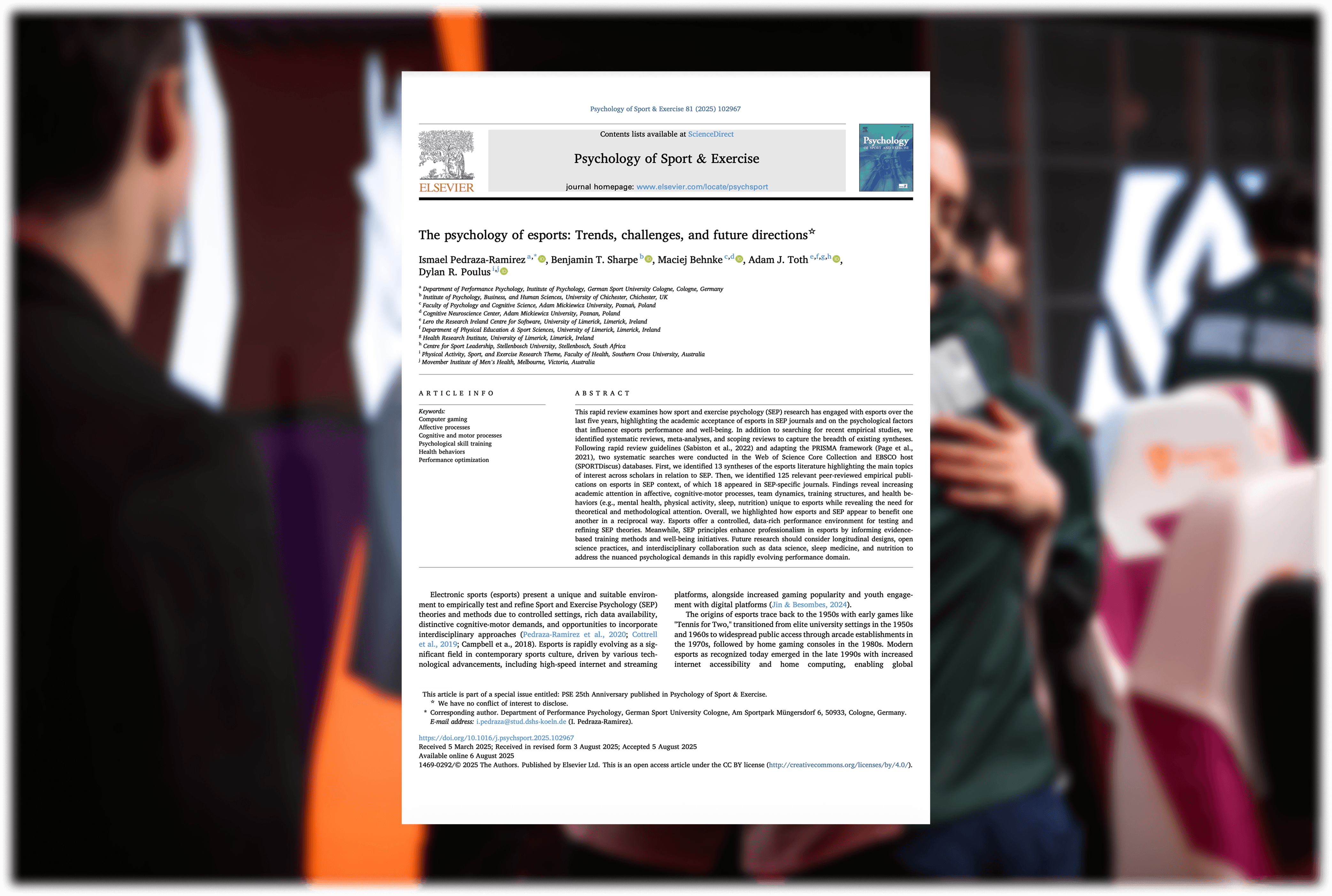
This rapid review by Pedraza-Ramirez et al. (2025) examines the evolution of sport and exercise psychology (SEP) research in esports from 2020-2025, analyzing 125 empirical studies and 13 synthesis reviews to map current trends and future directions. The findings reveal significant growth in academic acceptance, with SEP-specific publications increasing from just one study pre-2020 to 18 studies since 2020, demonstrating esports' establishment as a legitimate research domain. Research has concentrated on three main areas: affective and cognitive-motor processes underlying performance, team dynamics and training structures, and holistic health and well-being factors including mental health challenges like burnout and loneliness, alongside physical health behaviors such as sleep, nutrition, and physical activity. Despite methodological improvements with increased experimental designs (28.2%), the field faces persistent challenges including significant gender imbalance (35.2% male-only studies), limited diversity in participant samples, and concentration on specific games like League of Legends and Counter-Strike. The review concludes that esports offers a unique, controlled, data-rich environment for testing and refining SEP theories while simultaneously benefiting from evidence-based psychological principles, creating a reciprocal relationship that advances both domains.
Citation: Pedraza-Ramirez, I., Sharpe, B. T., Behnke, M., Toth, A. J., & Poulus, D. R. (2025). The psychology of esports: Trends, challenges, and future directions. Psychology of Sport and Exercise, 81, 102967. https://doi.org/10.1016/j.psychsport.2025.102967
Link: https://www.sciencedirect.com/science/article/pii/S1469029225001669?via%3Dihub